
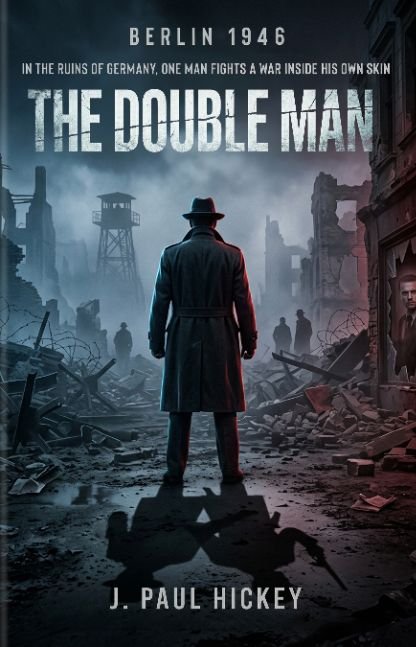
The Double Man
$14.85
Language : English
ASIN : B0HK1LKNXF
ISBN-13 : 979-8174650442


Description
J. Paul Hickey’s historical spy novel explores identity, survival, and moral pressure in the unstable world that emerged from World War II.
Most people think of identity as something fixed. A name. A country. A past. A set of memories that belong only to one person. But war can make even the most stable parts of life uncertain.
The Double Man puts identity under intense pressure. Set against the collapse of Nazi Germany and the uneasy political world that follows, the novel asks what happens when survival requires a person to become someone he never expected to be.
That gives the story one of its most compelling questions: How much can a person change to survive before that change begins to shape who he really is?
At the center of The Double Man is a young German soldier living through the final chaos of World War II. He shoots and kills an American GI and, in a panic fueled by fear and terror, steals the man’s identity and defects to the United States. The Wehrmacht soldier is not portrayed as a simple symbol of one side or another. Instead, J. Paul Hickey presents him as a man trapped inside forces much larger than himself and full of uncertainty.
That uncertainty matters because the novel is not only concerned with battlefield danger. It is equally interested in what happens to a person when the world around him changes faster than he can understand. The defector must constantly weigh survival against conscience as he is transformed and becomes an American spy against the Soviets back in his war-torn German homeland.
Changing how others see you is one thing. Changing how you see yourself is another. The new spy, with a new identity, must think carefully about language, behavior, background, loyalty, and even the smallest social details. What should he say? How should he speak? What does the person in front of him expect to hear?
The novel’s postwar setting makes that identity crisis even more powerful. World War II may be ending, but peace does not create immediate stability. Instead, new suspicions appear. Trust is a complicated thing in that environment. It is a precious and rare commodity. People are seldom what they seem. It is a world where it is wise to be wary even of the closest friends — they may have hidden objectives. Ordinary conversations can carry unspoken meanings. Officials may be protecting national interests. Others may have less pure motives.
Although The Double Man is rooted in the 1940s, its central concern extends beyond espionage. People still change themselves to survive. They adapt to new countries, careers, relationships, political systems, and social expectations. The novel takes that familiar human experience and places it under extreme historical pressure. And that leaves readers with a question that reaches far beyond the world of intelligence:
If survival depends on becoming someone else, how do you protect the part of yourself that must remain your own?